Pillow Buying Guide
Choosing Pillow Fill for a Firmer, More Supportive Feel
A firmer pillow can feel reassuringly steady, but firmness is not simply a property of the fiber inside. The amount of fill, the way it is contained, and the way it responds to your head all help determine whether a pillow offers useful support—or just feels hard.
Published November 10, 2026
There is a small but consequential difference between a pillow that feels firm and one that supports you well. The first may resist pressure. The second helps keep your head and neck in a comfortable position without creating a new point of strain. That distinction matters because a pillow can seem substantial in your hands and still compress too far overnight—or feel solid at first while pushing your head upward at an awkward angle.
Choosing pillow fill is one part of the decision. Resilient fibers, down-alternative microfiber and adjustable kapok each behave differently, but none guarantees a particular level of support on its own. Fill quantity, pillow height, casing, stitching and the sleeper’s position all influence the result. Even two pillows made from the same kind of material can feel noticeably different.
The most useful question is not, “Which filling is firmest?” It is, “Which construction gives me enough stable loft for my body and sleep position?” Answering it requires looking beyond the label and paying attention to how a pillow performs under pressure.
Firmness, loft and support are not interchangeable
These terms are often used together, but they describe separate qualities. Firmness is the resistance you feel when pressing into a pillow. Loft is its height, especially when it is resting without a head on it. Support describes how effectively the pillow helps maintain a comfortable position as it compresses and shifts during sleep.
A high-loft pillow is not necessarily firm: a generous amount of soft fill may compress substantially. Nor does a firm pillow necessarily provide the right support. If it holds too much height for your build or sleep posture, it can keep your head tilted rather than level with your spine. A low pillow can create the opposite problem for someone who needs more height.
Think of the pillow as a responsive layer, not a rigid prop. It should yield under your head while retaining enough structure to prevent excessive sinking. The best balance is personal. It can depend on shoulder width, mattress softness, preferred sleep position and whether you move between positions during the night.
That is why a single firmness scale rarely tells the entire story. A “firm” designation can help narrow the options, but it is not a universal measurement across brands or fill types. Where possible, assess the pillow in the position you actually sleep in, and check whether the maker offers multiple firmness levels or an adjustment feature.
How common pillow fill types behave
Materials influence the way a pillow compresses, rebounds and distributes pressure. They can also affect maintenance, temperature and sensitivity to particular materials. The following differences are useful starting points, not guarantees: construction and fill density can change the feel as much as the fiber itself.
Resilient fiber fills
Some fiber fills are designed to recover their shape after being compressed. Their spring-back can help a pillow feel more consistent from one part of the night to the next, particularly if the fill is distributed evenly and the casing keeps it from migrating. A resilient pillow may suit someone who dislikes the deep, yielding feel of very soft fill.
Resilience is not the same as firmness. A pillow can rebound quickly yet still compress easily under the head. Look for information about construction, fill amount and firmness options, and notice whether the pillow needs frequent fluffing to restore its shape. Over time, repeated compression and care practices can affect how well any fill maintains its original loft.
Down-alternative microfiber
Down-alternative pillows use synthetic fibers, often selected to create a light, soft, down-like feel. Depending on the fill and construction, they may offer a plush surface with a more structured response. Many are available in soft, medium and firm versions, making the firmness choice more explicit than it is for some single-profile pillows.
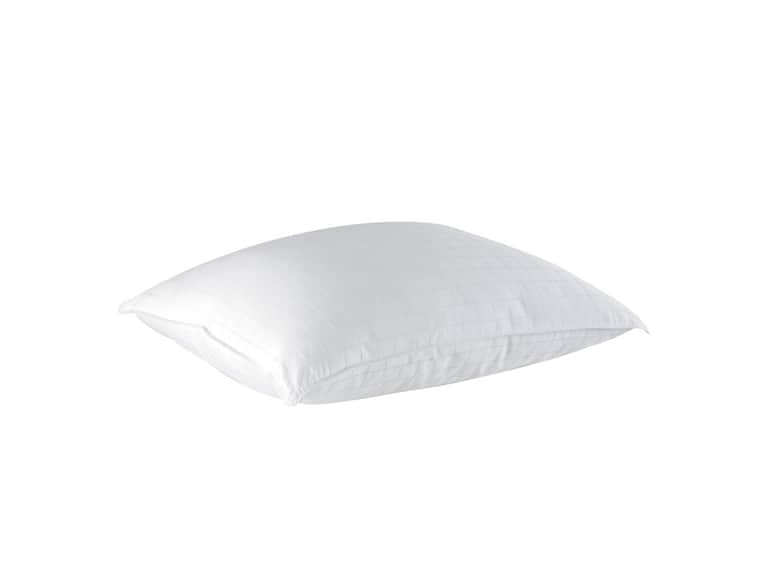
For example, the DownTown Company Alpine Loft Down Alternative Pillow uses DownEssence micro-denier fiber and a 100% cotton cover. It is offered in soft, medium and firm options. The product description presents it as a down-like, hypoallergenic alternative; individual sensitivities vary, so shoppers should review the materials and consider their own needs rather than treating a general label as a medical guarantee.
Down-alternative fill can be a practical place to begin if you want a familiar, plush feel and a choice of firmness levels. Confirm the care instructions before buying: washable construction may be convenient, but not every pillow or fill is intended for the same cleaning method. A washable protector can also help limit routine soil and extend the time between deeper cleaning.
Adjustable kapok
Kapok is a natural plant-based fiber used as pillow filling. Adjustable designs typically include a zipper or other opening that allows some fill to be removed or repositioned. This matters because a pillow’s effective height and firmness are influenced by how much material is inside it. Adjustability can make it easier to tune the loft rather than accept a fixed shape.
The practical advantage is control: a pillow that feels too high or dense may be altered gradually, then tested over several nights. Make small changes rather than removing a large amount at once, and keep any extra fill in a clean, sealed place if the manufacturer permits it. Removing fill does not automatically improve support, however. Too little can make the pillow collapse, while excessive fill can create pressure or an unsuitable angle.
Kapok’s feel varies with the pillow’s design and fill quantity. If you are considering an adjustable pillow, check how it opens, whether the fill can be added back, and what cleaning is recommended. The ability to adjust is useful only if the construction makes the process manageable and the pillow remains stable afterward.
Down and other natural fills
Down is known for its lightness and compressibility. Depending on fill amount and construction, a down pillow may feel soft and moldable rather than firmly supportive. Some sleepers value that pliability; others prefer a pillow that keeps more of its shape. Wool and other natural fibers have distinct weights, textures and care requirements, so it is worth comparing product specifications rather than assuming all natural fills behave alike.
Natural materials are not automatically more supportive, just as synthetic materials are not automatically less comfortable. The relevant questions are how the finished pillow responds under your head, whether its height suits you and whether its care needs fit your routine.
Start with your sleep position
Sleep position offers a practical way to estimate the pillow height you may need. It is not a precise formula, and mattress feel, body proportions and personal preference can shift the answer. Still, posture can help identify why a pillow feels too flat or too tall.
- Side sleepers often need enough loft to fill the space between the head and mattress, including the space shaped by shoulder width and mattress compression. A pillow that collapses too far may leave the head angled downward. One that is too high can angle it upward.
- Back sleepers commonly look for moderate height that supports the natural curve of the neck without pushing the chin toward the chest. A firm, overfilled pillow can feel supportive in the hand but raise the head too much once it is under pressure.
- Stomach sleepers often prefer less loft because a tall pillow can turn the head sharply to one side. A softer, lower pillow may be more comfortable for some, though individual needs vary.
- Combination sleepers may benefit from a pillow that can adapt to changing positions or recover its shape without needing constant rearrangement.
These are starting points, not rules. If you share a bed, your pillow choice is still individual: a partner’s preference for a high, firm pillow does not establish what your neck needs. Pay attention to how you feel on waking, but do not treat a pillow as a substitute for medical advice if you have persistent pain or other health concerns.
Construction can make or break a firm feel
Two pillows with similar materials can perform differently because of how they are assembled. Fill quantity affects both density and height. A tightly filled pillow may resist compression, while a more generously filled but softer pillow may feel lofty and still sink quickly. Neither description tells you how well it will keep your head in a comfortable position.
Chambered or compartmentalized construction can help keep fill in place, while a simpler design may allow the contents to shift more freely. Seams and the casing also matter: a tightly woven shell can contain fine fill and affect the surface feel, while the shape of the pillow determines how it can be arranged beneath the head and neck.
When reading a product description, look for concrete details: the type of fill, available firmness levels, whether the height is adjustable, the shell material and the recommended care. Marketing phrases such as “cloud-like” or “supportive” can describe an intended feel, but they do not replace those specifications. If a listing leaves important details unclear, ask the seller before purchasing.
A practical way to compare firm pillows
Shopping becomes easier when you compare the same questions across options. Instead of choosing by a single adjective, consider how each pillow behaves and what it asks of you in return.
- Identify your current problem. Does your pillow flatten, feel too high, bunch up or require frequent reshaping? A firmer fill may help with one issue but not another.
- Estimate the loft you need. Consider your primary sleep position, shoulder width and how much your mattress gives beneath you. Treat this as a starting point for comparison, not a measurement to follow blindly.
- Compare firmness levels within the same model. Firmness labels are not standardized across all makers. Comparing soft, medium and firm versions from one line may be more informative than comparing labels from unrelated products.
- Check adjustability and return terms. Adjustable fill offers a way to change height, while a trial or return policy can reduce the risk of choosing an unsuitable feel. Read the actual conditions before relying on either.
- Consider care and durability. Review cleaning instructions, whether a protector is recommended, and how the manufacturer expects the pillow to be maintained. A pillow that is difficult to care for may be less practical in daily use.
- Give the pillow a fair test. If the seller permits it, try the pillow in your normal sleeping position and allow time to assess it. Make sure its height, not just its initial firmness, feels appropriate.
Care affects how support lasts
A pillow’s feel can change as it is used. Fill may flatten, shift or gather in particular areas; covers can accumulate skin oils and dust; and unsuitable washing can damage materials or their ability to rebound. Following the maker’s care instructions is a modest but important part of maintaining the original feel.
Use a pillow protector if recommended and wash it regularly according to its label. Avoid washing the pillow itself unless the care instructions say it is safe. When a pillow is designed for fluffing, gentle redistribution may restore a more even surface. With an adjustable model, changes should be gradual, and removed fill should be stored cleanly if it might be needed later.
No fill type lasts indefinitely. Persistent flattening, lumps that cannot be redistributed or a shape that no longer suits your position may be signs that the pillow has reached the end of its useful life. The timeline varies by materials, construction, care and use; condition is more informative than a universal replacement date.
The better question is how the pillow responds
For a firmer, more supportive feel, look for a pillow that combines appropriate loft with controlled compression. Resilient fibers may appeal if you want a shape that rebounds; down-alternative microfiber can offer a familiar soft feel in different firmness options; adjustable kapok may allow you to fine-tune height and fill quantity. Each approach has trade-offs, and the material name alone cannot settle the choice.
A useful pillow should not demand that you hold your head in position against it. It should respond to your weight, retain enough structure to avoid excessive sinking and feel comfortable in your usual sleeping posture. That can mean a firm pillow for one person and a more yielding, adjustable one for another.
Read beyond the headline claims. Check the fill, construction, loft, care and return policy, then compare those details with your own sleep habits. The most supportive choice is not necessarily the hardest pillow on the shelf. It is the one that gives you a steady, comfortable fit through the night—and remains practical enough to care for over time.